
Worldbuilding: Geography, Setting, & Cartography
Your fantasy story needs to happen somewhere, and you need a map.

Every story needs a setting, and for those of us writing second-world fantasy and sci-fi, we are in charge of deciding what that setting will be. It is no small task. As with every part of worldbuilding, deciding the shape your world will take can be done in many different ways, varying by personal preference, amount of work you want to put into it, and even by stories themselves. That unfortunately makes it hard to give advice on.
As someone who has meticulously planned out entire realms before writing a thing, and drafted an entire book with hand-wavy non-specifics, I’ll give it a shot regardless.
Basis & Geography
Before getting into specifics, first you have to understand where you are starting from. Does the story form the landscape, or does the landscape form the story?
The Landscape forms the story:
When I was creating a “homebrew” world to run a dnd campaign in, I began with the world. I had an idea for “the Dragonspine”, a range of mountains that, when mapped, appeared to be the skeletal remains of some ancient wyrm. I had no reason for this, but it’s what got my ideas started. I ended up with an interesting map that already had a baked-in legend (and I didn’t have to decide whether it was true or not). The map also organically gave a reason why humanity was separated from other species in the realm, as they were tucked away in the North, cradled by the ‘tail’ of the serpent.
Thus the campaign plot unraveled: A human king was attempting to merge the human kingdoms into an empire he could wield against their elven neighbors to the south. Beneath the surface, the ‘bastard emperor’ was being influenced by a cult attempting to resurrect the gods of chaos from their divine imprisonment. All because I wanted some silly snake mountains!
The Story Forms the Landscape:
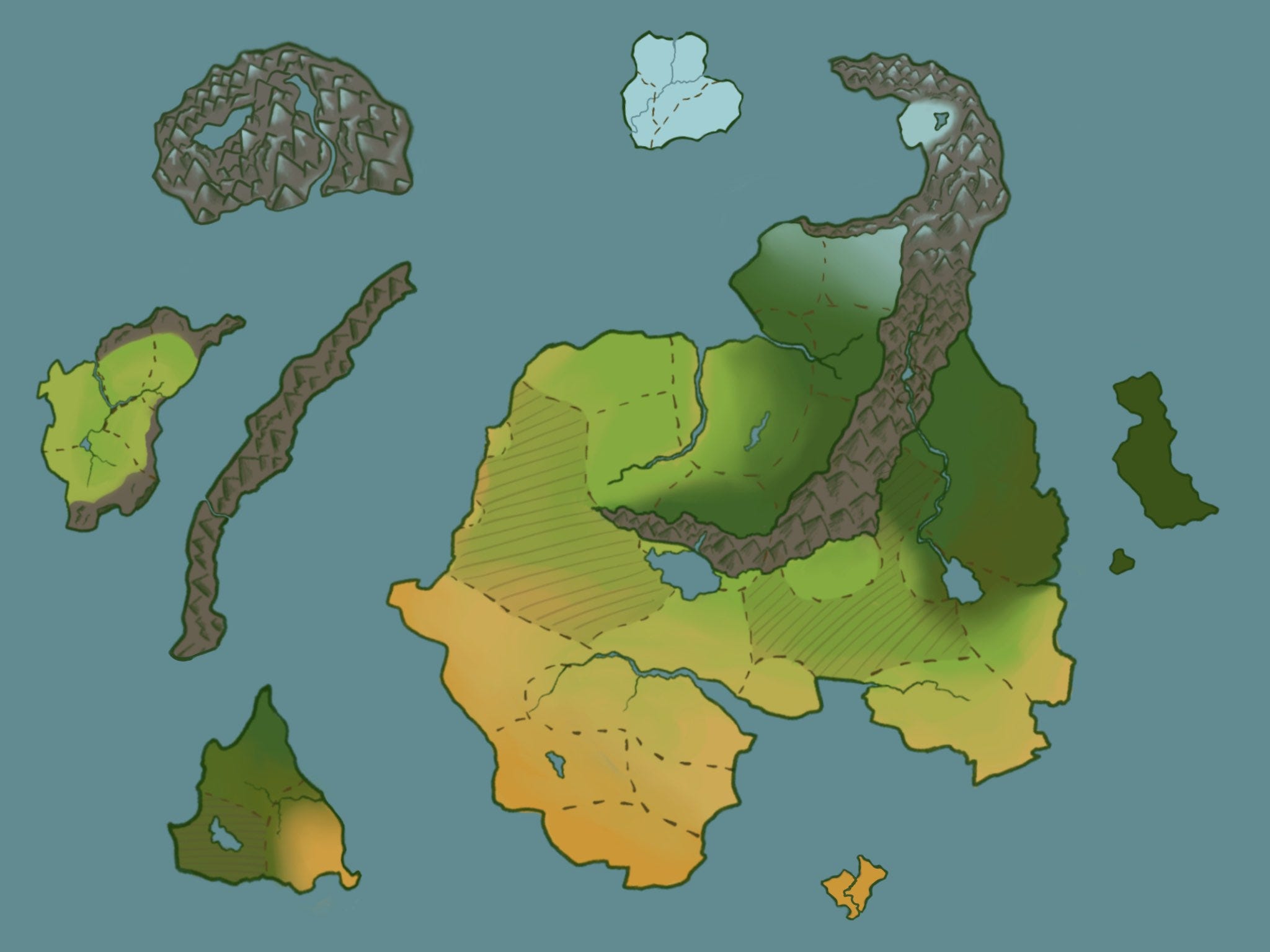
When I started worldbuilding for Ekhypso, however, I already had a fully-fleshed story to craft the world around. The first draft was finished at 80k words with no specifics about location. Originally, Inhumans was going to be an urban fantasy, but there wasn’t anywhere that felt completely ‘right’. I never could have imagined how much the decision to set it in a fantasy realm would shape my writing the way it did; so many new stories would come from it, and existing ones would slot into it like they had been made to. Considering Inhumans is set in a modern era, I had to not only make a map, but a realms history. As the timeline began to shape itself a thought about time itself came to mind (I’ll be writing another post about that too, at some point!) to answer how the realm was created. The story of the Breaking, the First Age of Ekhypso, and how time began—Maledictum Chao.
If you’ve read my short stories Ante Fractionum or Rodica’s Rest, you are acquainted with the first age. The former story is the first thing I wrote for the MalChao story itself. Originally, it was going to be the prologue. Though I haven’t worked on it beyond the zero draft, the story it tells is still integral to the formation of Ekhypso as it becomes known for the rest of time. Most notably: it necessitates an entire region of the map disappear.
I didn’t have a shape in mind for the realm or continent. All I knew was that there would be something that was there in the first age and gone for the rest. I wanted this change to be drastic, a scar on the land that served as undeniable evidence of the cost the realm paid for survival.
This story component directly influenced the way I crafted the map. I decided that the biggest impact would be, quite simply, losing the very core of the continent.
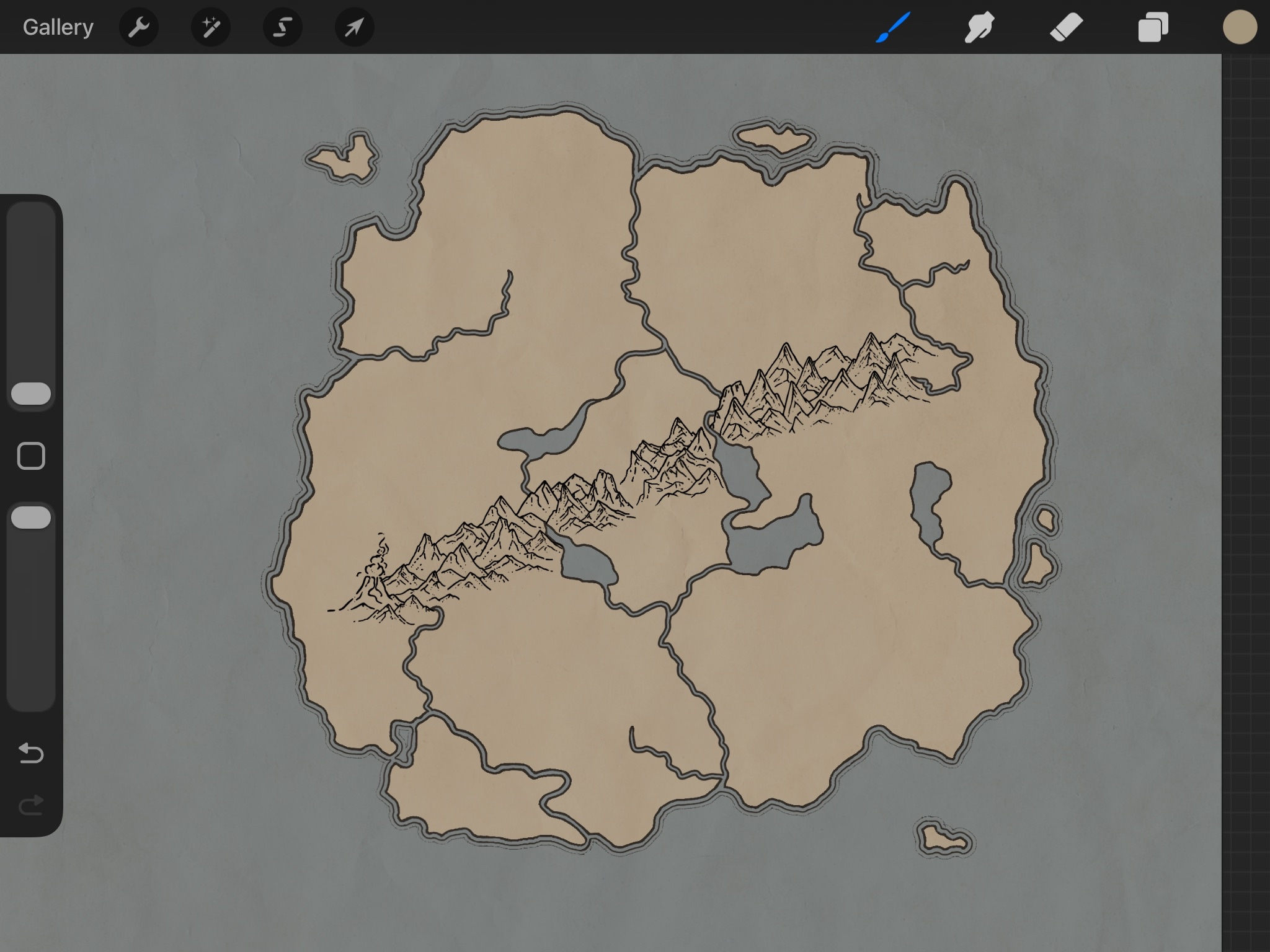
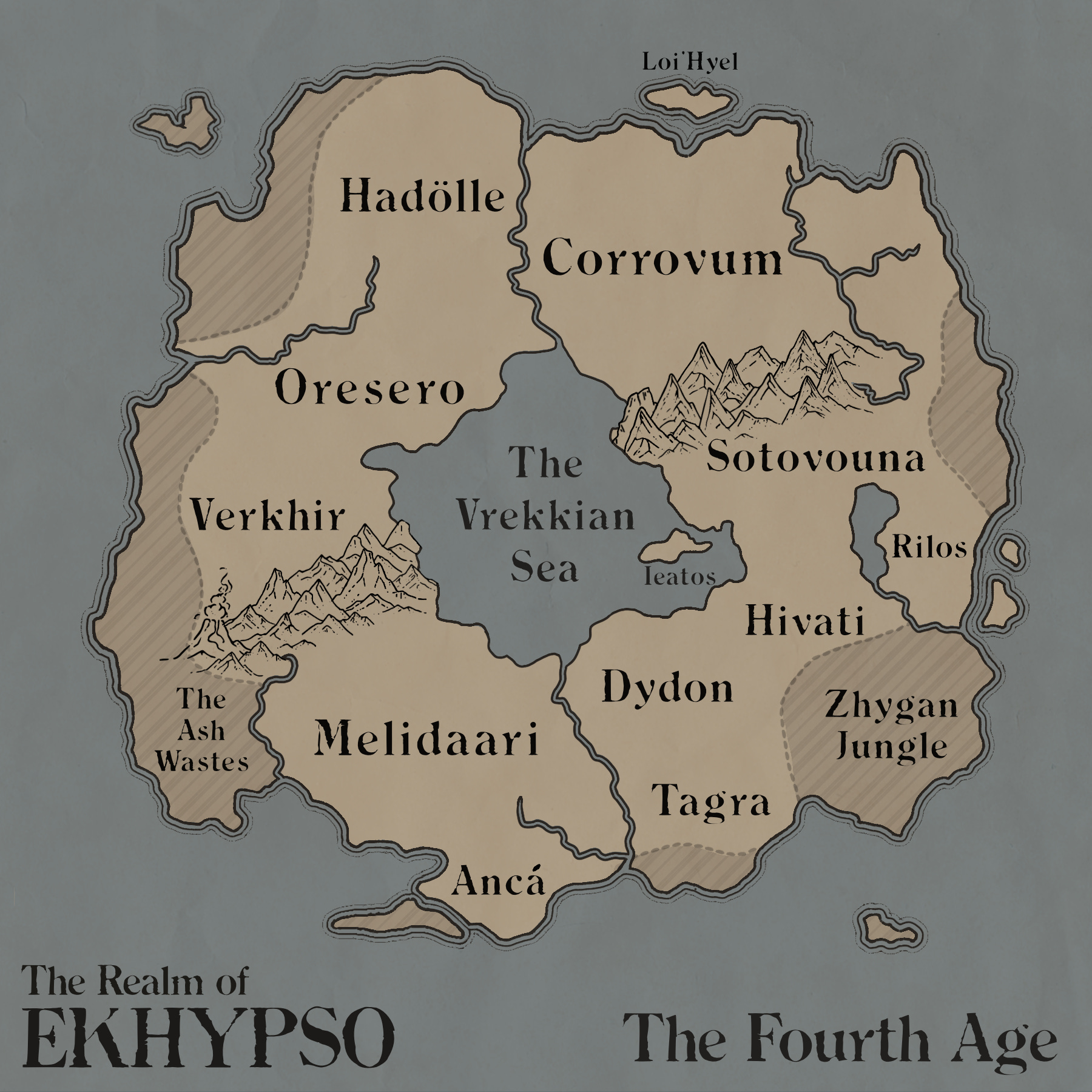
Such a large transformation evoked further questions. For how long was the lost kingdom remembered? When and why did that change? How did that alter the way the other kingdoms interacted with each other? With the kingdom gone, the map looked like a lovely little donut. This inspired my decision that the inhabitants referred to their post-Breaking continent as ‘the Wheel’.
Though the story of the Breaking would be lost by the time of the modern era, what information had been formed in the process ended up helping the Inhumans story. It answered questions I had not yet asked. It gave more history and context to weave in, more options to explore, and other opportunities to make that story better than I had planned. It grounded the story, growing roots that sunk deep into the soil of the world. And that, I think, is the most beautiful part of worldbuilding: the cycle of creation. The story creates the world which creates the story, on and on, feeding itself. So much discovery happens in the process.
Setting & Environment
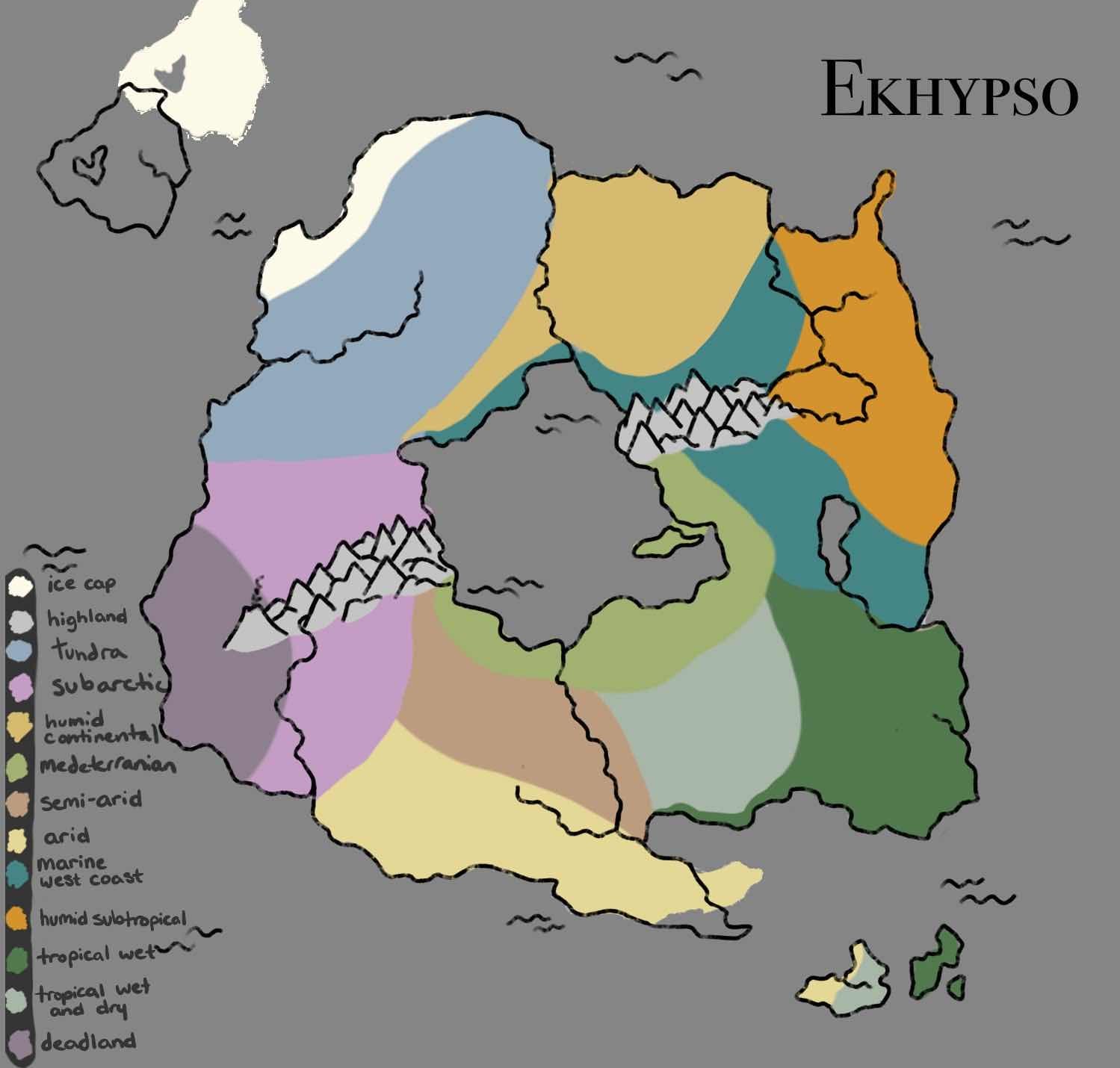
Whether the impetus of a new map was story or setting, the next factor I like to consider is environments. Think climate, terrain, and even solar system. This is definitely a point where your focus here can be as brief or in-depth as you want it to be. For some stories, the answer of ‘why is there a forrest here’ will be ‘because its my fantasy realm and I said so’. And that is just as valid as the method I followed while making Ekhypso (read: adhd riddled deep dive into climate zones that I obsessed over yet now only remember the vibes of).
Before I did my climate zone research, I had the basic idea of a sliding scale of hot to cold (NW to SE) and wet to dry (NE to SW). I also had to ask myself how fantastical I wanted it to be. Especially in sci-fi scenarios, we could be looking at multiple suns or moons. But I decided that I quite simply did not want to calculate how those factors would alter time, weather, tides, or any other information. It’s up to you how much you want to explore!
Scale
By now you should have the outline of a map and an idea of what the land looks like. So… what next? Well, you have to chop up that land into nice little sections! At this point, you can ask yourself what you want the scope of your world to be. If it’s a sprawling realm of many continents and kingdoms, you have a lot to work with. Maybe you want there to only be a few kingdoms that you can then focus on more completely, and thus they appear larger.
For Ekhypso I landed somewhere in the middle. I didn’t want something massive, but I also didn’t want just a kingdom or two. As I created the timeline I decided that there originally are only a few kingdoms that form during the first age. Over time, they fracture off here and there into independent countries. The map reflects the changing realm. It also gives each of the ages their own specific focus, or flavor.
Scale does not equal focus.
Worlds are overwhelming! And not every story is an epic adventure that takes the protagonist to every corner of the map. If you want your world to feel large but don’t want to mark out the nitty gritty details of every country or kingdom, simply zoom in your focus to one region. For my dnd world, I was a bit overwhelmed when I popped that full map out. But since that first campaign was primarily set in the human territories, the map I actually paid more mind to was simply of that region:
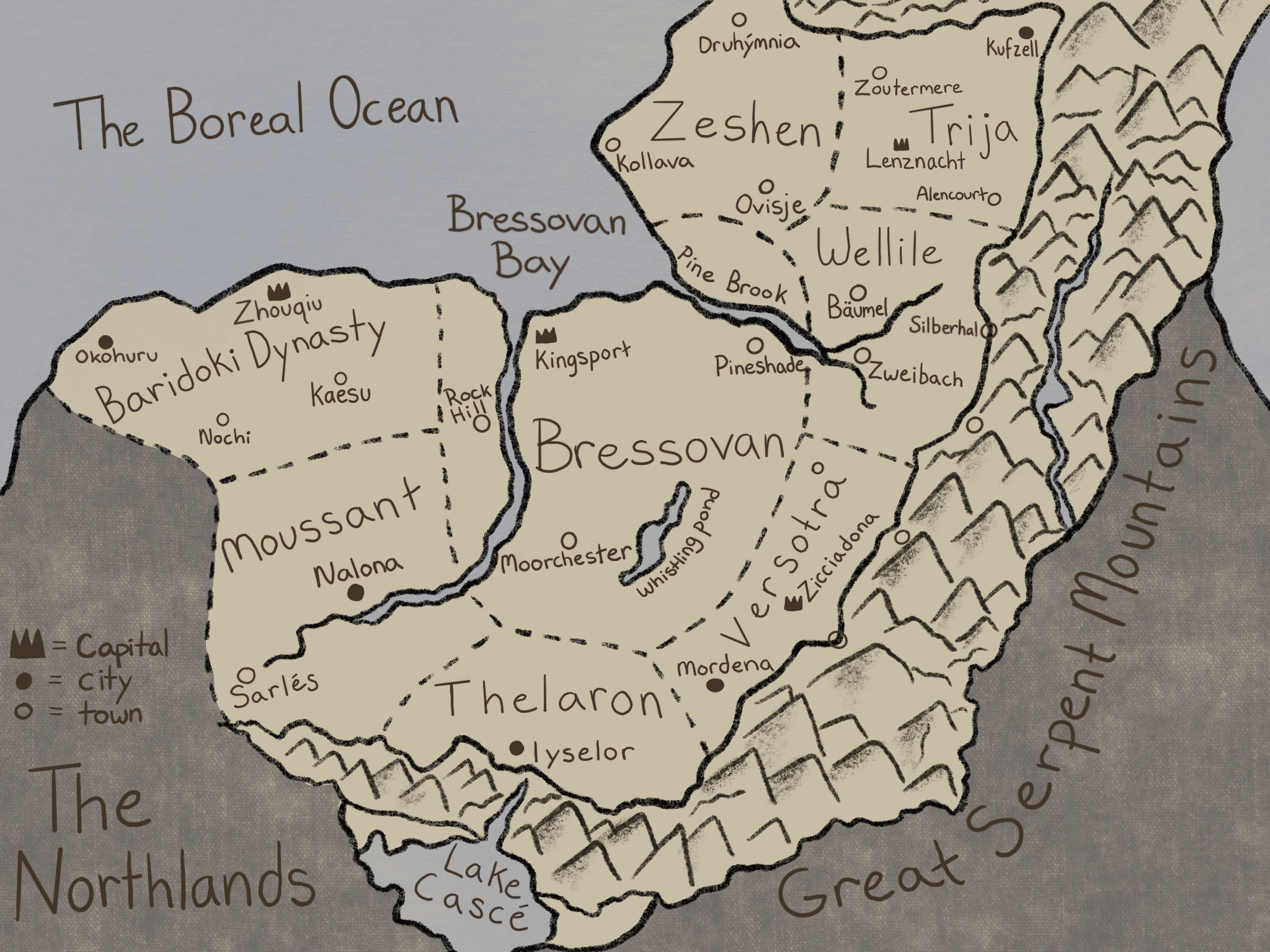
And even these region maps were basic. No roadways, no landmarks. Just boundaries, cities, and towns. This allowed both for the feeling of a sprawling fantasy realm, but also a map that wasn’t overwhelming to the players who were new to the world. (And I didn’t have to come up with a hundred town names right off the bat). I would later develop another region of the world in preparation for a subsequent campaign.
With Ekhypso, I’ve named all of the countries, but haven’t drawn many more specific maps. Aside from one project that I started that was set entirely in Sotovouna. Just one country. I said, “Alright, that’s doable!”
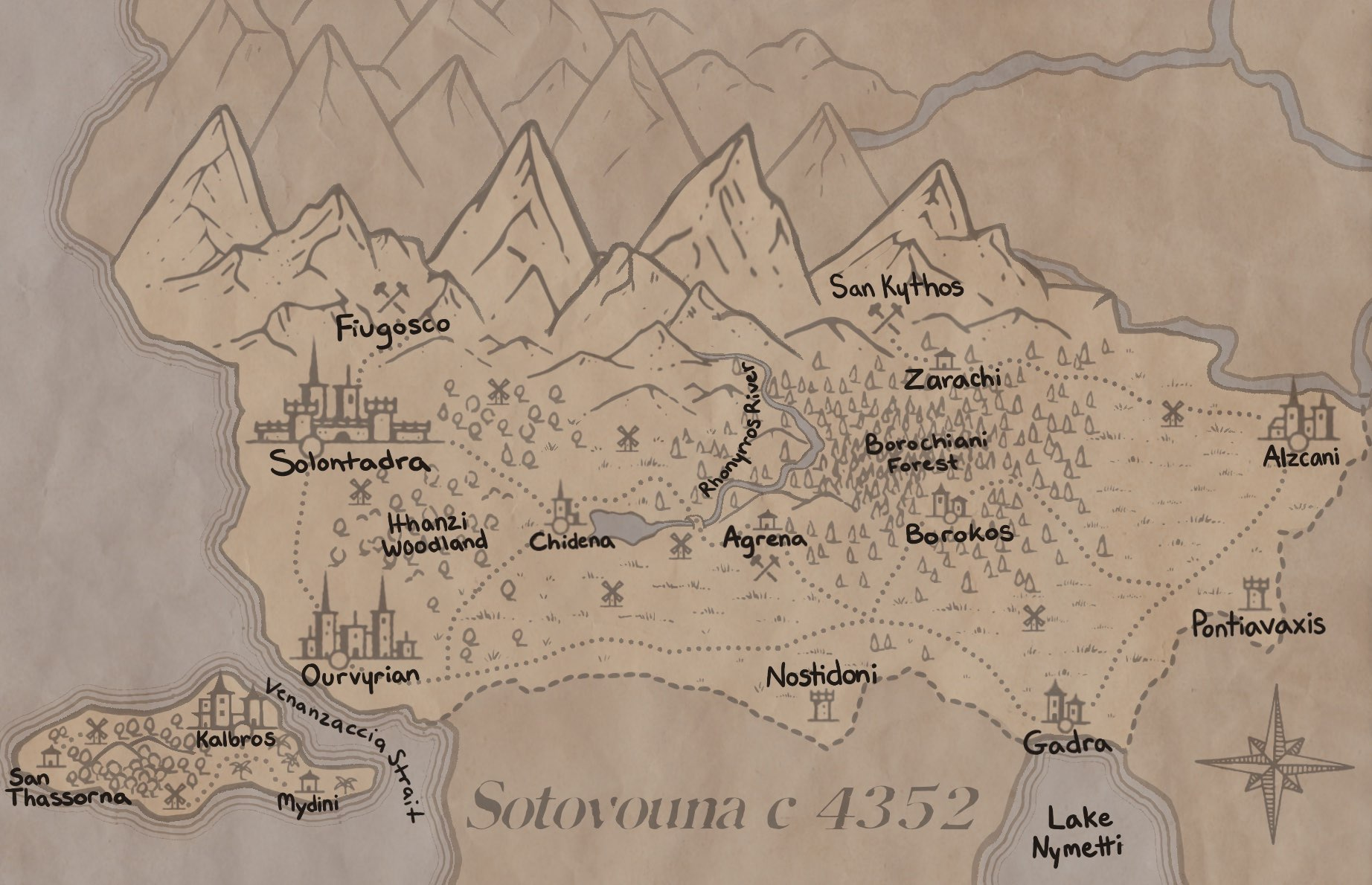
(And, between these two maps, I made the very wise decision of purchasing a mapmaking brush set so I wasn’t drawing everything entirely by hand)
Trust the process
You don’t have to have everything figured out right away. You don’t even have to start with a map. Your creative process is entirely your own—and, as I said, may even change from story to story! It’s only finalized once you say it is. Don’t be afraid to mess around with it as much and for as long as you want. Or maybe you’re perfectly happy with what you come up with the first go.
That’s why it took me so long to share a map of Ekhypso. It was in constant flux. I changed the orientation, altered the spelling of continents, moved entire countries, spawned and despawned islands. It took a lot for me to feel like it was ‘right’. I technically haven’t finished marking the map to show the changes of each era, but that’s okay, because I’ve locked in the basic geography and that’s the biggest part! The version I did finish focused on the Venatio era, AKA the fourth age, as this is the setting of both my serial Hunters & Heretics and my paranormal romance manuscript.
Whether making one detailed map, or a handful of basic ones, crafting the environment your story takes place in not only grounds the story, but adds to it. It’s a learning process. It’s another facet of the creativity muscle that all writers stretch. If you haven’t tried making your own map, I think you should give it a try!
Have you created your own world maps before? What does your process look like? There are sooo many facets to worldbuilding that I love to tear into shreds, and I love to pick other minds about their opinions on it too, so let me know what you think!
Thanks so much for reading.
Until next time,
M.K. Moretti
needed to read this right now. Loved this, especially the idea that the world and story keep shaping each other as you go. The Dragonspine vs. Ekhypso examples made that contrast really click. Also, scale ≠ focus is such a good reminder. super reassuring.
Love seeing all the different version change and grow! I'm constantly playing with mine but the shape is something I'm struggling with. I have a rough idea of what is where, so I just go off vibes for that for now lol. I need to do a zoom in, but then I'm going to have to think of more place names 😆